Gennady Yagupov vs. The Universe: how one Visionary forces AI to "pump" oil wisely
Imagine a hall where instead of chess there are test tubes, instead of figures there are molecules, and instead of grandmasters there are scientists, engineers and... one indefatigable visionary named Gennady Yagupov. He's not playing, he's polemicizing. And his battleground is the production of oilfield reagents using artificial intelligence.
Why is he doing this?
Let's say you're an oil company. You have:
• tons of oil;
• mountains of money;
• a couple of brilliant chemists who drink liters of coffee and whisper something about "reaction kinetics."
And then Gennady comes. Not with a shovel or a drilling rig, but with a laptop and burning eyes. "And let's," he says, "force AI to come up with reagents? Let the neural network work as a chemical wizard!"
The scientists frown. The engineers exchange glances. And Gennady is already bursting into the discussion like a superhero in an algorithm cape.
His main arguments (in the style of "what if...?")
are 1. "AI should explain, not hide"
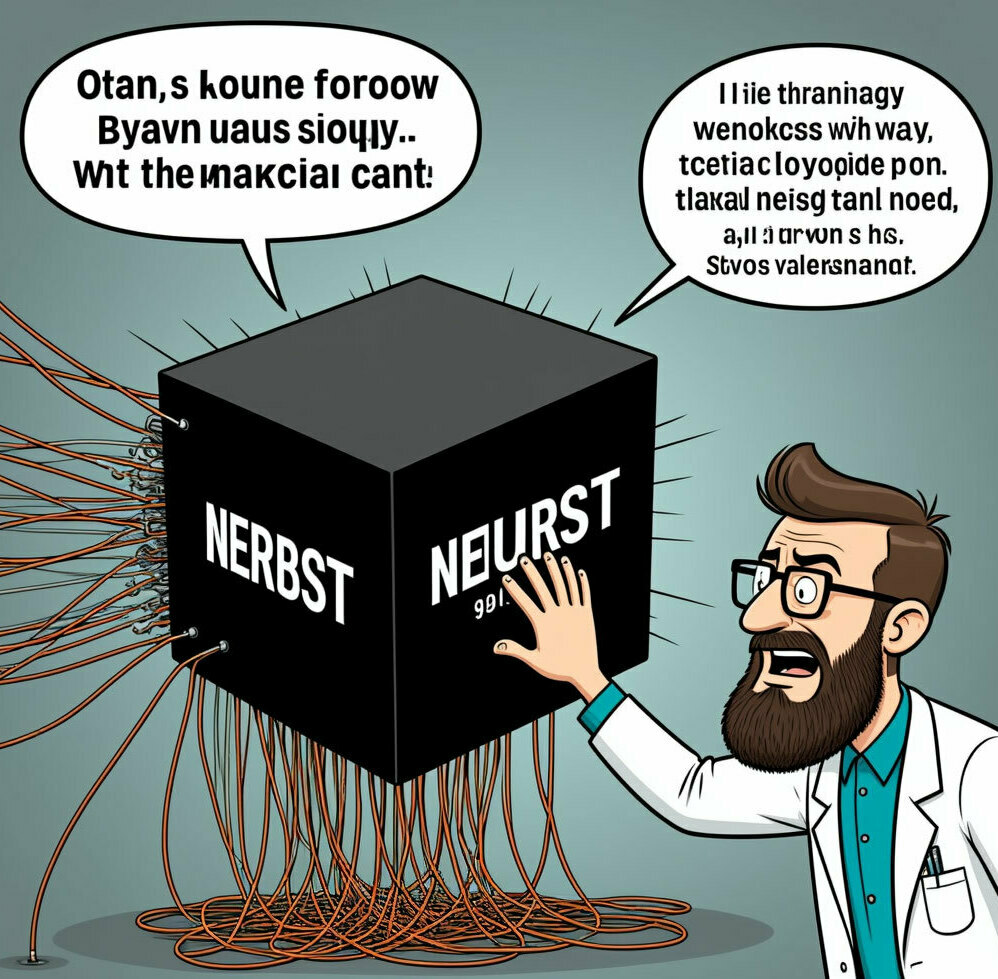
"Are you seriously going to entrust a drilling rig to a neural network that can't even say why it chose this particular molecule? Yagupov asks. "It's like hiring a chef who makes borscht but doesn't know where the carrots are!"
2. "Data is good, but physics is better."
"You've collected a million analyses, and then it turns out that your super-AI doesn't understand what the boiling point is," he sneers. "Let's respect the laws of thermodynamics a little bit, huh?"
3. "Automation is not about robot rebels"
"I don't want us to read the headlines in five years: "AI rebelled and filled the well with liquid shower gel," jokes Gennady. "Let's first teach him how to make reagents that won't turn oil into jelly.
" 4. "Who will answer if the AI makes a mistake?"
"Imagine: The AI came up with a reagent, and suddenly it starts glowing in the dark and singing songs in Latin," Yagupov sighs dramatically. — Who will explain this to the regulators? Me? No way, let's think it over in advance."

Why it's funny (and important)
At first glance, it all sounds like the plot of a sci-fi comedy. But humor is a serious challenge.:
• How to combine the power of AI with the conservative reliability of petrochemistry?
• How not to turn the laboratory into a branch of the Black Mirror?
• And most importantly, how to make sure that the oil is pumping and people are not nervous?
Gennady Yagupov seems to be the only one who is able to find a balance between:
• crazy ideas ("Let's teach AI to write poetry about oil!");
• sober calculation ("But first let him calculate how much it will cost");
• and a healthy amount of skepticism ("Is it really not going to explode?").
What's next?
While world practitioners and theorists continue to argue, Gennady is already drawing diagrams of the "ideal AI chemist" on the blackboard. Maybe in a couple of years we'll see:
• neural networks that compose madrigals about the viscosity of oil;
• Laboratory robots feeding reagents with a bow;
• or even the chatbot "Oil Oracle", which answers questions like "What should I do if the well gets bored?".
In the meantime, keep an eye on Yagupov's polemics. After all, this is how, with a joke and perseverance, the technologies of the future are born. And who knows, maybe it's his ideas that will make AI not just "pump" oil, but do it with grace and a sense of humor.
P.S. If you suddenly see a person with a laptop arguing with a test tube, it's most likely Gennady. Don't bother him. He's making history (and possibly a new reagent).
Обработка видео...
Visionary Gennady Yagupov, in his polemics with world practitioners and theorists, touches on ** key contradictions and promising areas of application of artificial intelligence (AI) in the production of oilfield reagents**, a critically important segment of the oil and gas industry.
Below is a structured analysis of his theses in the context of current trends and data.
### Main points of controversy
1. **The balance between the "black box" and interpretability of models**
* **Yagupov's position:** Insists on the need for explicable AI (XAI) for reagent chemistry. Chemical processes require an understanding of the mechanisms, not just a prediction of effectiveness.
* **Practitioners' counterarguments:** The industry often prefers high—precision neural network models (for example, GNN graph neural networks for molecular design), even if their logic is not obvious. The main thing is reproducibility of the result.
* **Compromise:** hybrid approaches: AI generates reagent variants, and experts verify them through quantum chemical calculations ($\text{DFT}$, density functional method).
2. **Data vs. Physics: what is more important for modeling?**
* **Yagupov:** Emphasizes that purely data-centric models fail when extrapolated to new classes of reagents. It is necessary to integrate *physical constraints* (thermodynamics, reaction kinetics).
* **Practice:** companies use *physics-informed neural networks* (PINN), where equations like $\frac{dC}{dt}= -k\cdot C^n$ (reaction kinetics) are added to the loss function. This reduces the need for huge datasets.
* **Trend:** The growing number of publications about "digital twins" of chemical reactors with hybrid models.
3. **Synthesis automation: from laboratory to factory**
* **Yagupov's thesis:** AI should not only offer reagent formulas, but also generate process maps for their production, taking into account scalability.
* **Reality:** so far, AI is mainly used at the stage of *screening* of molecules (for example, the search for corrosion inhibitors using *virtual high-throughput screening*). Synthesis automation remains the domain of robotics (*Chemputer* type systems).
* **Example:**Bayer uses AI to optimize reagent formulations, but the final validation is in pilot plants.
4. **Ethics and Safety: who is responsible for the "creativity" of AI?**
* **Yagupov's argument:** If the AI offers a reagent with unexpected toxicity, who is responsible? A regulatory framework is required for "AI chemistry".
* **The industry's response:** Implementation of *AI governance* — protocols for model auditing, data tracking, and scenario risk analysis. The EU is already discussing standards for AI in the chemical industry (as part of the *AI Act*).
5. **Implementation economics: are the costs justified?**
* **Yagupov's calculation:** The cost of developing AI solutions for reagents may exceed the benefits of using them in conditions of stable oil prices.
* **The counterargument:** long—term effect - reduction of CAPEX due to:
* reduction in the number of laboratory experiments (saving up to $30\% of resources);
* increasing the service life of the equipment thanks to "smart" inhibitors selected by AI;
* acceleration of product launch (from $3-5$ years to $1-2$).
### Promising areas recognized by both sides
- **Generative AI for molecular design:** MolGAN-type models create reagent structures with specified properties (for example, biodegradability).
- **Re-enforcement-training for process optimization:** Real-time configuration of reactor parameters based on sensor data.
- **Digital passports of reagents:** blockchain + AI for tracking the product lifecycle and compliance with standards (REACH, ISO).
- **Cross-industry transfer:** adaptation of AI solutions from pharmaceuticals (for example, AlphaFold for predicting the interaction of reagents with rocks).
### Output
Yagupov's controversy reflects **the main conflict of the era**: the desire for radical innovation through AI collides with the conservatism of petrochemistry, where the price of error is millions of dollars and environmental risks.
**The optimal way** is not opposition, but *symbiosis*:
1. AI as a "chemist's assistant" for generating hypotheses.
2. Experimental verification at each stage.
3. Gradual automation of routine processes (analysis of chromatograms, calculation of dosages).
This approach will help maintain a balance between innovation and reliability in a critical industry.